


Bullet Journal

Signs and Remedies of Bullet Journal BurnOut

Hello, everyone! Sorry this post is a couple of weeks late! Today is going to be a pretty simple and short post, but I figured it was something good to post about.

I Made a Decision

Recently, I made a decision about my bullet journaling.

At the beginning of the school year in August, I decided to start a bullet journal for a school planner. I was so excited, so sure I could be super organized and never miss a project or test. I was a little unsure about whether I’d have enough time to make the new pages each month, but I decided I would have plenty of time.

Well, turns out the junior year of high school is the hardest year. The first semester wasn’t so bad, but this semester has had me working long school days with not much time left for fun things at the end of the day. Not to mention, I was mentally exhausted, so convincing myself to do more work was hard. (This is also why I haven’t been posting, as I explained last week.)

At the same time, I also wasn’t able to get my normal bullet journal pages done. I didn’t even really have the energy to fill out my daily pages at the end of the day.

I knew something had to go. It didn’t make sense to buy a school planner for just the last few months of school, so I decided to take a break on my normal bullet journal for a few months, at least until summer.

I knew I just wasn’t really enjoying making the pages as much as I used to. It was also time for a new journal, and I knew I couldn’t start a project like that. So for now, I’m only doing my school bullet journal. This journal is much simpler than my other one was; just one monthly page and the weekly pages.

Signs That You May Need a Break

Here are some signs that you may need a break from bullet journaling:

  1. You aren’t enjoying bullet journaling as much as you used to. You can’t come up with good ideas for each month. You don’t enjoy making the pages and aren’t feeling very creative.
  2. You aren’t filling out your journal on a daily basis. If you can’t find the energy or incentive to fill out just your daily pages, then it’s definitely a sign to take a break.
  3. You’re getting sloppy. Your spreads aren’t as neat as they usually are, but you aren’t taking the time to fix them up.
  4. It’s taking up your time for other more important things. If bullet journaling is starting to take up your time for things of higher priority, such as time with family, school, and your hobbies, then you should take a break until you can find more time in your schedule.
  5. Doing your monthly pages are causing you stress. If you’re stressed about your journal because you can’t get it done on time, definitely take a break. Bullet journaling is supposed to take away stress, not cause it.

If you are experiencing any of those symptoms, you’ve probably got bullet journal burnout. That just basically means that you aren’t as enthusiastic about journaling as you used to be.

Remedies?

Yes, I’ve got remedies! Below are a list of steps you can take to get rid off bullet journal burnout.

  1. Take a break. Start with a week off from your weekly layout. If that isn’t enough, skip the next month. Skip the next few months if you need to. This break will let your mind take a break form the stress and worry your journal may be causing. You will come back refreshed and full of new ideas!
  2. Use something else as a planner in the meantime. While I’m taking a break from my bullet journal, I’ve been using either a notebook or app on my phone to make task lists. You can also make a list of appointments for the week.
  3. Let your mind take a break. Make sure you’re allowing your mind to take a break. Try not to think or worry about upcoming pages. If you come up with an idea for your next page or spread, make a list on your phone and then stop worrying about it. For your break to be a real break, your mind needs to rest, too.
  4. Plan your starting-back date. Determine how long of a break you need, and decide on either the week of or the day of your return to journaling. *Note: This is the day you will start using your completed pages. You will have already made your spreads by this week/day.
  5. Start planning your journal ahead of time. Give yourself at least two weeks before your start date to start planning and making your journal. Take it slow, being sure to stop for the day if you start to feel overwhelmed.
  6. Look on Pinterest or other sites for ideas. Even though you just had a break, it’s not a guarantee that you’ll be bursting with ideas and inspiration. Be patient with yourself and get ideas from outside sources instead of expecting yourself to automatically come up with ideas.
  7. Start your journal again! Let this day be a day of celebration! Fill out your journal!
  8. Keep at it! Now this is the hard part: making it a habit. Set aside fifteen to twenty minutes a day for journaling. Don’t be upset with yourself if you miss a day; just make up for it the next day.

I could write a ton more, but I am saving that for another post! 🙂

Until Next Time…

That’s if for now! I hope this post helped you!

Let me know down in the comments if you are struggling with bullet journal burnout! Feel free to ask any questions and I will do my best to answer them!

Thanks for reading! Happy writing!

But you belong to God, my dear children. You have already won a victory over those people, because the Spirit who lives in you is greater than the spirit who lives in the world. (1 John 4:4)
Bullet Journal

50+ Habits To Track In Your Bullet Journal

Hello, fellow bullet journalists! I hope you all are finding a way to stay cool in this hot weather!

Today, I’ll be sharing both habits to track in your bullet journal and different layouts for your habit tracker. I know this is kind of a random post, but I didn’t start working on my post until yesterday. Whoops!

What is a Habit Tracker?

For those of you who don’t know what a habit tracker is, it’s a page where you create a space to track what habits you want to keep doing and also those that you want to stop doing. This can be done in a bullet journal, in a notebook, or even on a piece of paper stuck on the wall beside your bed.

To create one of these, just sit down with a pen and paper and think about your daily routine. Start with the moment you wake up. Imagine yourself going through your day, writing down any habits you want to start or stop doing as you do so.

Layouts

I’ve only tried two different habit tracker layouts in the time I’ve been bullet journaling. I haven’t tried very many because the ones I’ve used have worked really well, so I didn’t feel the need to try new ones.

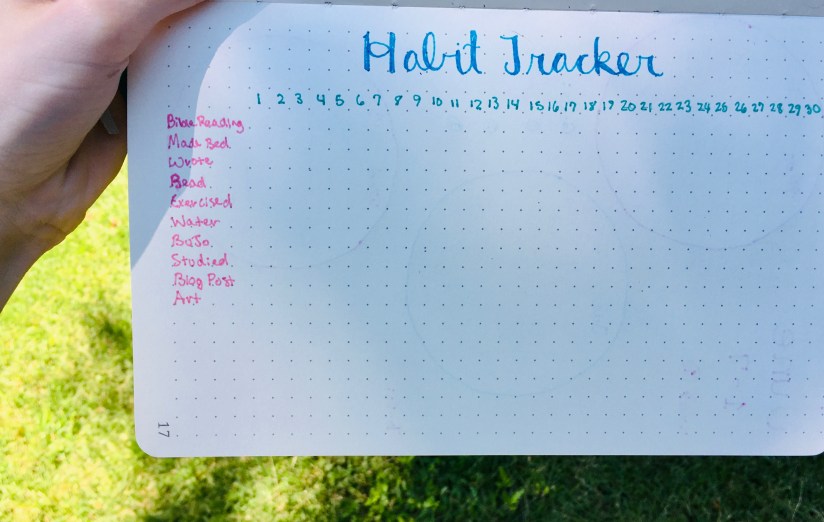
This is the habit tracker that I’ve used for most of my bullet journaling time.

  • How To Create It: It’s pretty simple: a title at the very top, the dates underneath, and habits that I want to track written down the side.
  • How To Fill It In: When you’re going through your tracker each day, make an x or some other mark (color it in, do stripes, etc.) in the appointed square to show you completed that habit.
  • Advantages: This layout is good if you are tracking a lot of habits. In this picture, I’m only tracking ten habits, but this page can hold up to at least seventeen (and even more if you use two pages). You can also do a few designs (flowers, cats, etc.) at the bottom to make it more interesting!
  • Disadvantages: There aren’t any disadvantages for this layout except for the fact that it does get tiring to use the same layout over and over again. That’s why I ended up trying the other layout I’m about to show you.

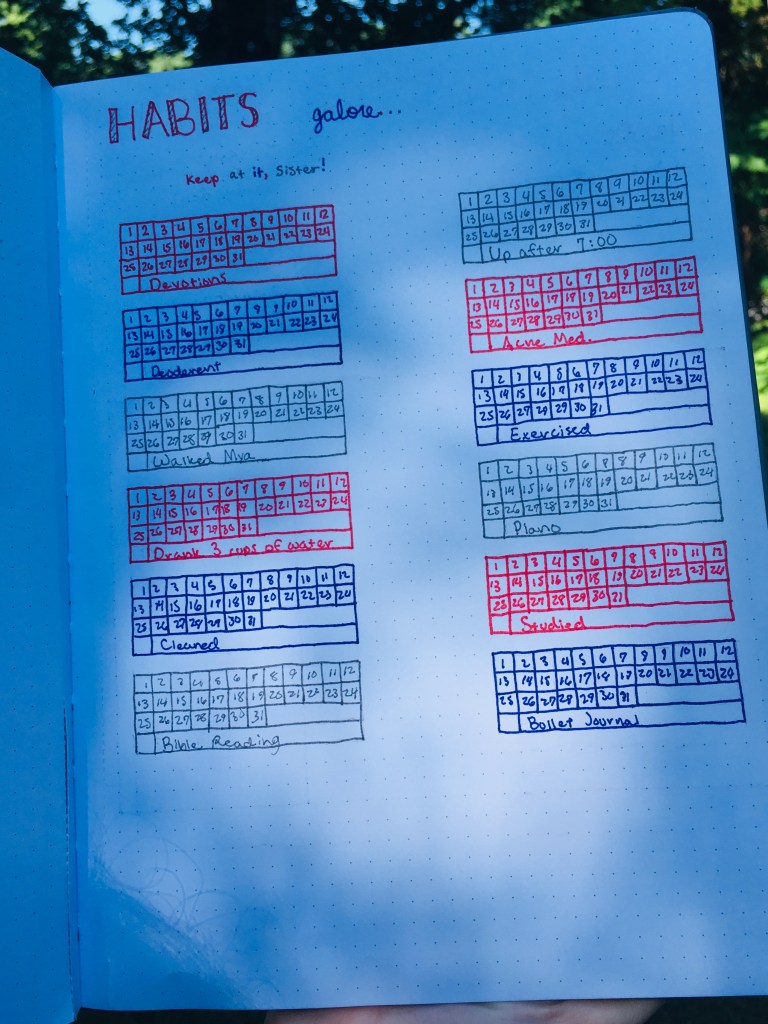
This layout is one I copied from a post on Pinterest.

  • How To Create It: For this layout, you just create mini calendars, with one square per day, and at the bottom, you can include an extra space to name your habit.
  • How To Fill It In: Each day, as you go through, if you completed the habit, then you color in the appropriate square.
  • Advantages: This one is also good for plenty of habits, but it can’t hold as many as the first layout can. On this page, I have twelve habits, but I think I could have fit about sixteen.
  • Disadvantages: I will say that I remember this one being difficult to fill out (using three different colors) and tiring to make (it’s not fun to write the same numbers over and over again). I suggest you fill them all out in in just one color, not three different ones. And this tracker layout is worth the mind numbing-ness of writing the same things over and over again!

Habits to Track

I’ve compiled a huge list for you guys of things you can track in your habit tracker. Some of these things will apply to you; some will not. The best thing to do is to just go through the list and ask yourself, “Do I need to work on that? Or am I doing pretty good in that area?” If you feel like you’re doing good, then you probably don’t need to track that habit. If you feel like that area needs more work, go ahead and track it. If you’re not sure about something, track it. Then, at the end of the month, you can look back and see your progress to decide if you need to track it again next month.

And now I’ll go ahead and jump right in to the list:

HEALTH

  1. Water consumption
  2. Calorie goal
  3. Brushed teeth
  4. Skin care routine
  5. Showered
  6. Hair routine
  7. Eating a good breakfast
  8. Step goal
  9. Exercised
  10. Floss 
  11. Medications/vitamins
  12. Stretched
  13. No or less smoking/alchohol/unhealthy snacks/sugar/caffeine
  14. Routine for fingernails and toenails
  15. Veggie/fruit servings
  16. Period tracker
  17. Getting good sleep

MENTAL HEALTH

  1. Writing
  2. Read 
  3. Spent time drawing
  4. Limit screen time 
  5. Track moods
  6. Journal 
  7. Meditate 
  8. Gratitude log
  9. Listened to music
  10. Spent time outside
  11. Enjoy a hobby
  12. Random act of kindness
  13. Reflect on your day
  14. Reduce social media time
  15. Reduce TV time
  16. Compliment someone

SPIRITUAL

  1. Devotions 
  2. Prayed
  3. Bible reading

PRODUCTIVITY

  1. Studied (for school)
  2. Worked on a project
  3. Paid bills 
  4. Grocery shopping
  5. Meal plan
  6. Make lists
  7. Prioritize
  8. Update bullet journal
  9. Do one task working towards a bigger goal
  10. Write down goals

HOUSE TASKS

  1. Cleaned
  2. Made bed
  3. Did dishes
  4. Changed sheets
  5. Laundry
  6. Ironing
  7. Put clothes away
  8. Watered plants
  9. Dust 
  10. Declutter 
  11. Recycle
  12. Pet care
  13. Chores

SOCIAL HEALTH

  1. Spent time with kids
  2. Spent time with partner
  3. Spent time with friends

See You Next Week!

Well, I hope you all enjoyed this post and found it helpful!

I’m going to start trying to post at the same time each week, but I may be late on some days (for instance, I’m a little bit late today). Check back at 2:00 pm EST on Friday for another post!

Thanks for reading! Happy writing!

Three things will last forever – faith, hope, and love – and the greatest of these is love. (1 Corinthians 13:13 NLT)